
< Back to Sanius content
The Night Shift in Medicine: Turning Sleep Into a Predictive Clinical Asset
Sleep is not a lifestyle accessory. It is clinical infrastructure. In our work at Sanius Health, tracking sleep has become one of the most revealing signals inside complex disease management, particularly for patients living with rare, ultra-rare, and long-term conditions.


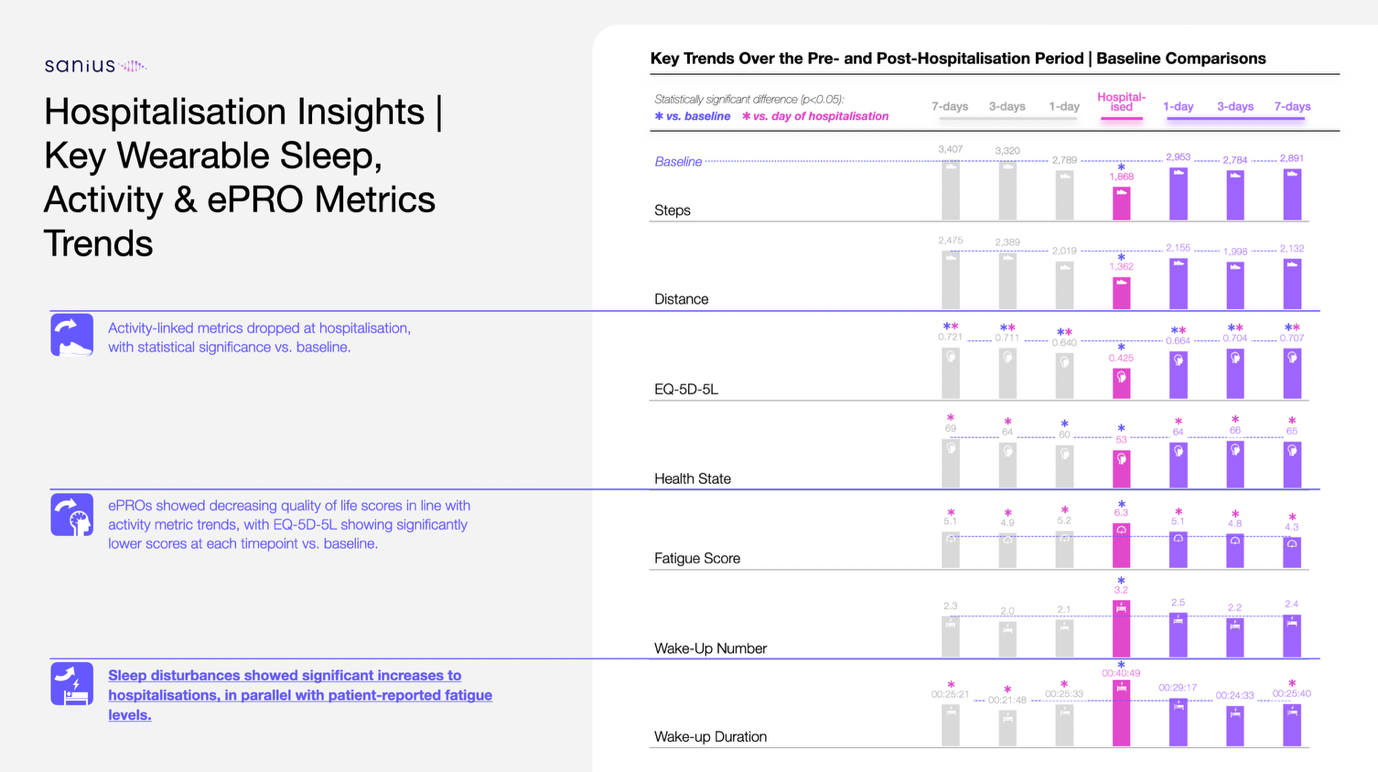
For years, we have embedded continuous sleep monitoring into our broader disease management ecosystem, not as a wellness feature but as a measurable clinical asset. Across thousands of patients in haematology, autoimmune disease, metabolic disorders and oncology, one pattern repeats itself. Fragmented sleep travels with fatigue. Fatigue travels with reduced adherence, lower resilience, and higher rates of complications. When we layered wearable-derived sleep metrics alongside longitudinal clinical data and patient-reported outcomes, the insight was clear. Sleep was not simply a byproduct of illness. It was a forward indicator. In multiple cohorts, deterioration in sleep efficiency preceded reported flares, infections or unplanned admissions. That sequence forced us to rethink how predictive modelling should work in chronic care.

Clinically, adults are advised to aim for seven to nine hours of quality sleep. Yet many patients with long-term conditions struggle to reach even six uninterrupted hours. The reasons are physiological and systemic. Pain, inflammation, medication cycles, anxiety and nocturnal symptoms disrupt normal sleep architecture. In sickle cell disease, nighttime pain and oxygen desaturation interrupt deep restorative phases. In myeloproliferative neoplasms, cytokine-driven inflammation and pruritus fragment REM cycles. In diabetes, glucose variability can destabilise sleep continuity. The data reflects the biology.
Patients sleeping fewer than six hours consistently show higher fatigue scores, lower activity levels the following day and, in some groups, measurable shifts in heart rate variability and glycaemic stability. Decades of epidemiological research have linked short sleep duration with increased cardiometabolic risk, impaired glucose tolerance and higher cardiovascular events. What has changed is our ability to observe these dynamics in real time, at scale, over months rather than minutes in a clinic room.

One patient living with a rare autoimmune condition described the shift plainly. “Before joining the programme, I was sleeping around five hours a night and waking up exhausted. Within three months, my sleep efficiency improved dramatically, my fatigue fell, and I have not needed an emergency appointment in over half a year. For the first time in years, I feel in control.” That is not simply a quality of life anecdote; it is a measurable change in risk profile.
There is also a strategic dimension. Payers and regulators increasingly expect real-world evidence that therapies improve daily functioning, not just laboratory markers. Sleep is one of the most sensitive indicators of functional recovery. When inflammation reduces or symptoms stabilise, we often see consolidation in sleep cycles before we observe shifts in routine blood panels. By presenting sleep data within regulatory-grade registries, we can demonstrate value in a language that clinicians, health economists and access teams understand. For patients, better sleep means sharper cognition, steadier mood and improved capacity to adhere to complex regimens. For health systems, it can mean fewer complications and more predictable utilisation.

Sanius Health was built as an advanced disease management ecosystem, integrating wearables, patient-reported outcomes, and longitudinal clinical data at scale. Sleep has emerged as both a barometer and an early warning system. The night shift in medicine is not about working longer hours. It is about recognising that what happens at night predicts what happens next. Ultimately, turning sleep into a predictive clinical asset is not a branding exercise – it represents a shift in how we define outcomes and, ultimately, how we advance care.
The patient experience shared.
Join the Sanius Health Community
Register your interest below and a member of our team will follow up with you soon.